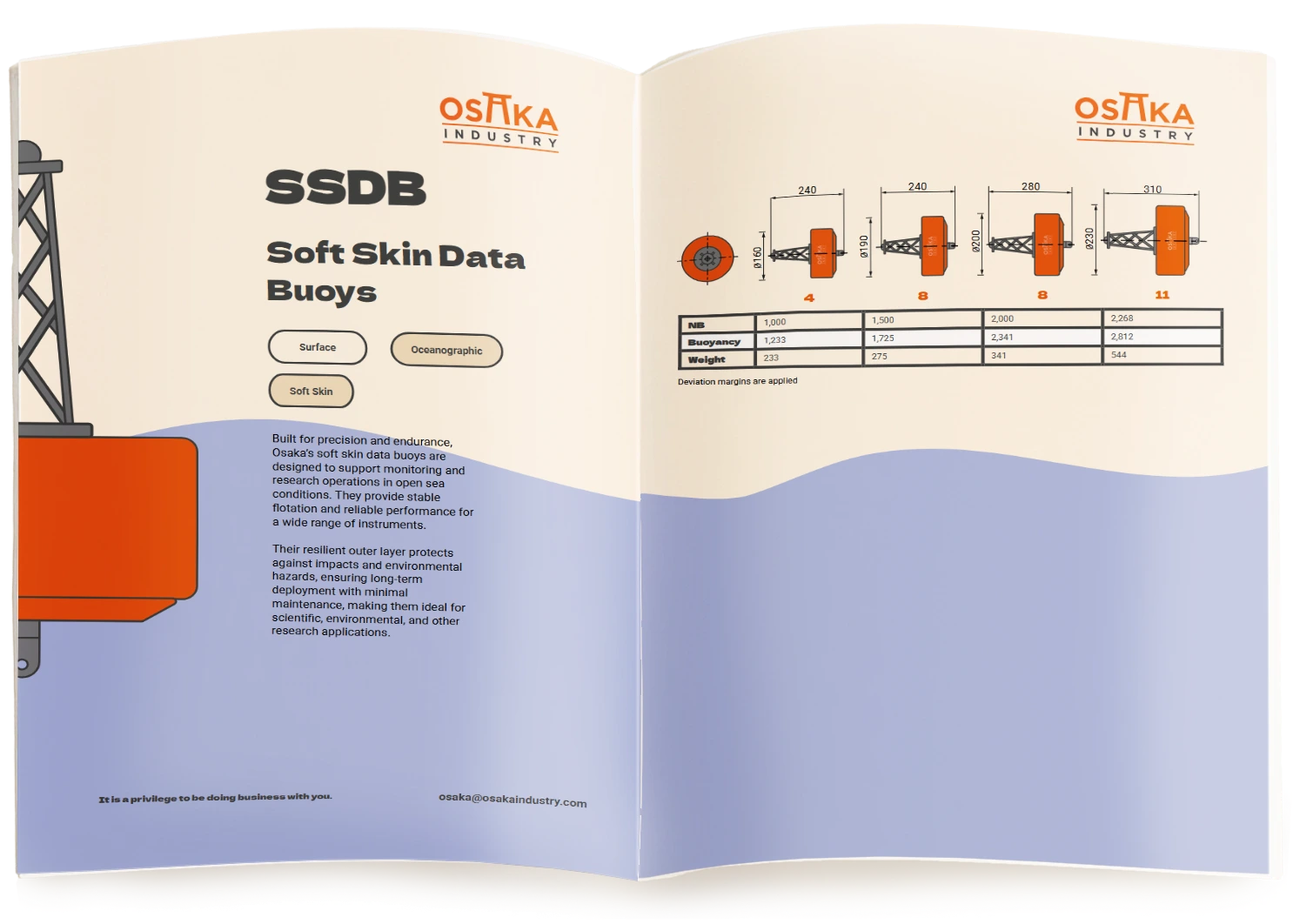
Our newest type of Data Buoys with soft skin body, in our catalog you fill find the product sizes and core specifications.
Get pdf
 Get a Quote
Soft Skin Data Buoys are instrumental oceanographic buoys, using our most advanced polyurethane soft skin protective technology. As a data buoy, it can be tailored to fit any required instrument.
Built for
precision and endurance, these buoys are designed to support
monitoring and research operations in open sea conditions. They provide stable
flotation and reliable performance for a wide range of instruments.
Their
resilient outer layer protects against impacts and environmental hazards,
ensuring long-term deployment with minimal maintenance, making them ideal for
scientific, environmental, and other research applications.
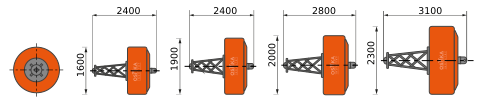
NOTE: Weight in kg. Measurements in mm.
These are our standard dimensions, after product customization deviation margins might apply.
Data Buoys can be built in sizes as small as 20 kgs of Buoyancy. Our standard sizes start at 1 ton of buoyancy, and up to 2.2 Tons of buoyancy for the Offshore applications in industries such as the Oil & Gas, or even Offshore Wind. These buoys are between 1.5 and 2.3 meters, they are large, stable, and allow heavy instrumentation to reliably be installed on top, with accessories such as solar panels, processing units, and anything that the customer decides to install on their large surfaces. Smaller and larger sizes are available upon request without inconvenience, as we are specialized not only on standard sizes, but also on custom sizes.
 Get a Quote
Offshore Industry Compliance:
Data Buoys designed and tested for prolonged use in the deepest waters, with strong currents and harsh weather. Osaka offers real End to End certification, customized in every project both on our standard and tailored models. These specialized buoys are designed, tested and manufactured in compliance with the typical requirements in the Offshore industry, as well as any additional requirements proposed by the customer, on any specific industry. This applies both to the buoy itself and the instrumentation or other equipment when sold together as a complete system.
ISO 9001:2015 Quality Assurance:
Quality Assurance at Osaka Industry meets the requirements of ISO 9001:2015, which is the standard that regulates Quality Management Systems (QMS), and is a fundamental but extremely important asset in any design or manufacturing company, as it is used to track, verify and control the quality of its products. Our Quality Management System is designed to give you, as a customer, full control over the quality of our products such as the Data Buoy, in every stage of production, so it ends up meeting your quality expectations. Buoys do not follow a specific standard or have class certificates like other maritime components, so assets like ISO 9001 management systems are fundamental.
quality@osakaindustry.com
Adjusting Standard Soft Skin Data Buoys:
All our standard sizes sizes are adjustable. We have a fixed range of standard data buoy sizes, which have been obtained from our most commonly requested sizes and different considerations for the types, sizes and weights of the instruments used, which should accommodate most standard equipment in industry. Some specific instruments may require sizes in between, or even larger sizes than standard, which is why we offer a nearly infinite number of in-between sizes, where the length, width or other parameters of the body of the data buoy can be adjusted to perfection.
Purchasing Custom Data Buoyancy:
Oceanographic or "Data" Buoys are highly customizable, we are able to deliver both the buoy itself that we specialize on, as well as the complete system with instruments, sensors, 4G or 5G modules, computing or processing units and other devices. All project specific, and adapted to your requirements. Furthermore, special materials, finishings or other aspects of the buoy construction are also highly customizable, in order to be able to provide stability for the sensors or to perform properly in the special conditions that the data buoy will be measuring.
Know What to Avoid:
The design "Body" of the Data Buoy is fundamental to ensure the safety and operability of the instruments that will be incorporated to the data buoy system. It is not sufficient with the buoy being simply enough to provide sufficient buoyancy to lift the weight of the equipment, parameters such as stability, sensitivity to waves and tides, height of the vertical top structure, and countless other details are needed to ensure the fit of the body to the oceanographic equipment. At Osaka Industry we have a full dataset of our projects, with the technical specifications of our buoys supplied, feedback from customers, manufacturing processes and installation details, which provides us with an objective framework for designing buoys, and in this case specifically data buoys, with a measurable record of success. At Osaka we recommend that just as you should compare prices between suppliers, compare their experience, their records, whether they explicitly mention specific and objective procedures for ensuring success, and whether they are backed by real assets such as our dataset, otherwise, you may have very little control over the quality of the product. Data Buoys handle expensive and extremely sensitive equipment, which is exposed to humidity, salt water and potentially harsh weather, and in many instances data buoys are measuring a specific variable for periods of years. In other words, it is a part of a more complex system, being certain about quality might be the difference between being able to measure your variables continuously and uninterrupted, or having a gap in your dataset of months due to the need to replace or repair faulty equipment, or simply a buoy that was not meant to handle such exposure or conditions for such time frames.
 technical@osakaindustry.com
Data Buoys at Osaka are built to achieve a long life span with minimum maintenance, making them suitable for surveying or monitoring tasks without interruptions, over long periods of time, even years. Their superior design is backed by quality materials and proper manufacturing techniques and finishings, all to ensure a consistent high quality that our customers can rely on, and have full control over. The quality achieved is such, that the construction of the buoys even meets tough requirements such as those of the US Coastguard, making them reliable even on the harshest conditions, and under extensive compliance requirements.
Rigid Internal Core:
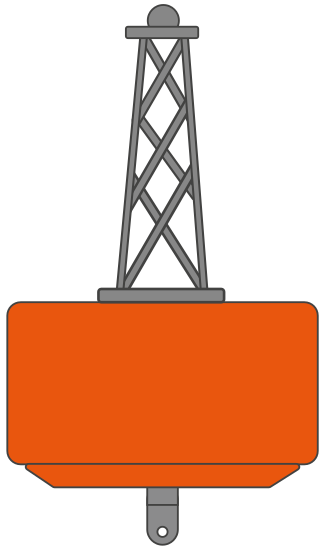
Instruments and electronic components are supported directly by a super-strong rigid steel core, which is the center of the construction of the buoy, is connected to the bottom pad eye connection to the anchor chain, and on the top is often followed by a support structure that achieves balance and is able to carry solar panels.
Enclosed Foam Core:
A rigid, high buoyancy foam surrounds the steel core, it is the main buoyant element of the buoy, and its rigidness helps secure the steel core in place even in extreme events such as collisions, preventing bends, fractures or other material deformities.
Bonding Foam Layer:
This layer of flexible foam protects the foam core from damages, it is designed to both be buoyant and have a high energy absorption capacity, similarly to how a foam-filled fender is constructed.
Outer Soft Skin:
A specially made layer that protects the entire internal body from the water, humidity, and salt. It is constructed with tense filaments tied in a pattern across the ends, that is then covered with a special finishing coating that makes the skin ultra-resistant, shiny, and stable.
technical@osakaindustry.com